



Environment Corporate Information / CSR
As a member company of the Nissan Group and in order to create a sustainable global environment in line with the environmental policies of Nissan Motor Co., Ltd., Nissan Trading Co., Ltd. aims to propose solutions and to provide high value-added services to realize the environmental responses that our customers are aiming for.
Under Nissan Motor Co., Ltd.'s medium-term environmental action plan, the "Nissan Green Program 2030," we are working to provide the global supply of materials and parts that is necessary to realize CO2 reductions through innovative manufacturing and through electrification and vehicle intelligence, to propose optimal commercial distribution and logistics routes to reduce environmental burden, to promote high circulation the high circulation of and efficiency in the use of energy and natural resources through the material recycling business, to reduce the burden on the environment through corporate activities, and to coexist with resource consumption and ecosystem services.
Nissan's Environmental Philosophy of "A symbiosis of People, Vehicles and Nature"
Environmental Policy
Nissan Motor believes that the basis of environmental protection and conservation is a manifestation of human "gentleness." In addition to deepening true awareness of the environment by each and every one of our employees, we will contribute to the development of a more prosperous society by utilizing in all our corporate activities, such as car manufacturing and sales, this "gentleness" that takes people, society, nature, and the earth into consideration.
We will reduce the environmental dependence and load that is caused by our business activities and cars to a level that nature can absorb, and we will pass on abundant natural assets to the next generation.

Ultimate Goal
We will reduce the environmental dependence and load that is caused by our business activities and cars to a level that nature can absorb, and we will pass on abundant natural assets to the next generation.
What We Want to Be:
A Sincere Eco-Innovator
- Sincere
- Proactively address environmental challenges and reduce our impact on the environment.
- Eco-Innovator
- Develop a sustainable mobility society through innovative technology in products and services.
Key Issues and Challenges to Address
We will address the following key issues in the Medium-Term Environmental Action Plan "NGP 2030" to realize a sustainable and harmonious society with nature.
- Climate Change:
Carbon Neutral - Toward the goal of carbon neutrality by 2050, strive for electrification potential and Monozukuri innovation.
- Resource Dependency:
No New Material Resource Use - Drive circular economy by efficient and sustainable use of resources, and by creating a system that maximizes the use of mobility.
- Air quality and Water:
Zero impact/Zero risk - Reduce water usage and manage water quality in response to the regional issues and reduce the impact on air quality by minimizing emissions from cars and corporate activities.
Environment-Related Business
Nissan Trading is stepping up its recycling business, which recycles used parts and batteries. Our aim is to realize a recycling-oriented society, in response to the rapid transformation that is underway in the automaker industry. We are also contributing to reductions in CO2 emissions and to the supply of sustainable energy through our participation in Japan’s Power Producers & Suppliers (PPS) system which uses renewable energy.
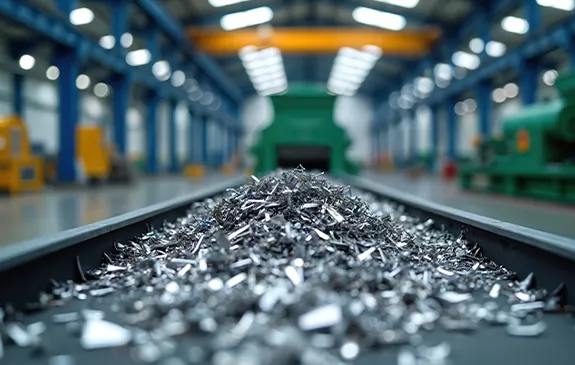
Nissan Trading’s recycling business (scrap recycling)
Since 2007, Nissan Trading has been centrally managing steel scrap generated by Nissan Motor Co., Ltd. and its affiliated companies. Following this, by expanding the scope of recycling from steel scrap to include aluminum and other materials, we have been helping to bring about carbon neutrality through the effective use of limited resources.
Nissan Trading is also recycling resin parts such as automobile bumpers through our resin recycling business, and we are expanding this business through our partnerships with resin recycling companies.
Initiatives aimed at realizing a recycling-oriented society
Nissan Trading is creating systems for collecting and recycling steel, aluminum, copper and resins originating from vehicles, as well as the lithium-ion batteries (LIBs) which are essential for electric vehicles (EVs), and re-using these in new vehicle parts and materials.
Steel and aluminum:
Melted down and remolded, to be reused in vehicle bodies and parts.
Resins:
Collected from bumpers and similar parts, and reused in new resins.
Lithium-ion batteries:
Nissan Trading is making progress with initiatives for extracting the nickel, cobalt and lithium used in these batteries and supplying these as materials for new batteries.
Through these activities, Nissan Trading aims to make progress towards carbon neutrality and the effective use of resources, helping to build a recycling-oriented society.


Power Retailing Business (PPS)
Nissan Trading started operating in the power retailing business under Japan’s Power Producers & Suppliers (PPS) system in February 2015.
The Nissan Denki initiative
In December 2024, Nissan Trading began selling electricity to the general public within the service area of Tokyo Electric Power Company (TEPCO), drawing upon the knowhow we had already developed through supplying electric power to corporations; then in October 2025, we expanded the retail area of this system to cover Japan as a whole (excluding outlying islands and Okinawa).
Nissan Denki supplies 100% effective renewable energy to consumers.
Approximately 70% of all CO2 emitted by households originates from electricity generation. Expressed in terms of the cedar trees required as a carbon sink, this amount of CO2 would require 130 trees*1 per household to absorb it. In Nissan Denki’s system, Non-Fossil Fuel Certificates (NFCs)*2 are acquired from Feed-in Tariff (FIT) power generation plants; these represent the environmental value of the renewable power. Separated out from the power they were originally generated from, these certificates can be attached to other electric power (which can include thermal power), which can then be supplied to users as “100% effective renewable energy,”*3 a form of environmentally-friendly power.
Simply by using Nissan Denki, consumers can cut their net CO2 emissions to zero, helping to preserve the environment.
Our partnerships
Nissan Trading is working in partnership with Osaka Gas Co., Ltd.*4 not only for the wholesale supply of electric power but for supply-demand management, aimed at ensuring that the demand for and supply of power is properly balanced.
-
*1Source: Calculated from values taken from the website of the Ministry of the Environment. (https://www.env.go.jp/content/000122573.pdf
 ) / Calculated from values taken from materials created by the Forestry Agency, Ministry of the Environment: “Carbon sink-related measures using greenery to prevent global warming.”
 -
*2Non-Fossil Fuel Certificates (NFCs) are certifications of the environmental value of electricity originating from non-fossil fuel energy sources. They are certified under Japan’s Feed-in Tariff (FIT) system.
-
*3Electricity generated through thermal power generation and similar sources is considered to constitute “100% effective renewable energy” once NFCs (representing the value of renewable energy) have been attached to it.
-
*4Partnerships with Osaka Gas and with companies connected with Daigas Group (Osaka Gas’s group company).

Supplying electric power with selected PPS partner companies
By working with other partner PPS companies, Nissan Trading can offer proposals tailored to customers’ needs in terms of costs (reducing electricity bills), the environment (reducing CO2 emissions), and other aspects.
Nissan Trading’s demand optimization business (energy management)
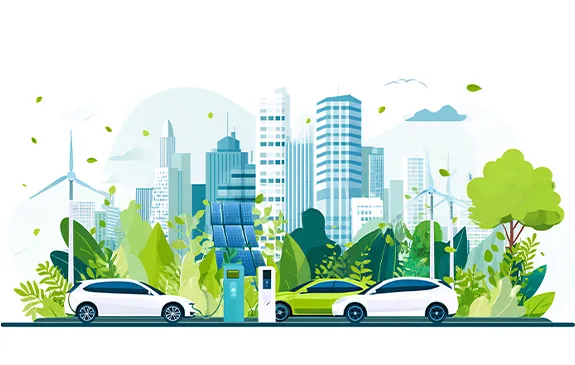
Nissan Trading is rolling out energy management services which use EVs.
“Energy management” refers to mechanisms which monitor the status of electric power usage in buildings in real time, and ensure that power is received at optimized timings through the use of autonomous controls. Nissan Trading’s energy management services make use of EVs to reduce power costs through load shifting and peak shaving, without any loss of convenience in terms of using the car. Furthermore, when these systems are coupled with renewable energy generated by solar panels and similar sources, they can also contribute to energy decarbonization and to local energy self-sufficiency.
Nissan Trading delivers one-stop services that aim to provide customers with support for introducing the system, and to offer different kinds of value suited to different customers, to bring about widespread adoption of energy management services.
Special features of Nissan Trading’s services
Support for introduction:
Nissan Trading can propose the ideal system for meeting each customer’s needs.
One-stop services:
All needs, from system design to operation, are handled within a single setup.
Delivering individualized value:
hese services can deliver solutions meeting the unique needs of each customer.
Nissan Trading is continuing to work with partners that share its vision of bringing together EVs and energy with the aim of realizing a carbon neutral society.

NITCO × Project
"People" Who Create New ValueIn order to support automobile production, it is indispensible to have not just knowledge of logistics, but also knowledge of automobile production and knowledge of material technologies.
Here, from a variety of perspectives, we introduce the "businesses" of Nissan Trading, the "people" who work there, and the "places" where businesses are born.
Related Page